.jpeg)
'25-'26 Dev Corner: PACF and the Spectrum of Filipino Indigenization
- USC Troy Phi
- Feb 9
- 3 min read


October 29, 2025
Hello Troyphi! I hope the school year has been fun and eventful, with midterm season almost ending (hopefully)! Midterm season is difficult for everyone, and for many students, this month can propagate an unhealthy culture of burnout, lack of sleep and food, and avoidance of self-care. I encourage you and folks around you to check in on each other, invite people to do fun things, and get out of Leavey, even give a small little gift such as food, a message, or a hug. It is not healthy to push one’s body and mind to their limits, so take time in the rest of this semester for self-care.
Today, I’d like to reflect on my love for PAHM (Pilipinx American History Month), especially PACF, the double consciousness of Pilipinx-Americans, and the variety of ways that we as a community have tried to connect with our Filipino roots. Most of these ideas are directly inspired by Carl Lorenz Cervantes, or @sikodiwa on Instagram, who researches Philippine Folk Psychology and culture. I highly recommend reading his work.
Filipino-Americans yearn to connect to their cultural roots, but have difficulty entering it and connecting without their own family, especially when far away from home in college. This sparks events like PAHM and PACF, born out of solidarity with the Filipino culture and community, back in one’s home and across the ocean. When we journey through our collective history, bringing our personal knowledge of our Filipino culture, we hear of the concept of indigenization, the act of regaining or revisiting the cultural values and practices that have been lost due to Westernization. For me, this concept recognizes a spectrum of reclamation and reinvention, a spectrum of thought and principle influenced by our colonial and national history, and which embodies the Filipino spirit.
On one end are those who seek a full rejection of colonial mentality, striving to revive precolonial intuitions: the language of baybayin inscribed on skin and digital art (reminiscent of our Office Hours Baybayin Workshop), the movement of singkil echoing ancestral pre-colonial Muslim stories, and the ritual and rhythm of dances like tinikling, bulaklakan, and maglalatik performed with renewed reverence. On the other end are those who embrace the inevitability of hybridity, believing that Filipino culture is inevitably saturated with Western culture and symbols, and that the adaptation of these symbols and repurposing them for our own, like Jeepneys, OPM, and even Jollibee, is a revolutionary act. Authenticity is not about purity but resilience, the ability to take what was foreign and make it our own. The Philippines, after all, has always been a meeting point of worlds: Austronesian roots crossed with Chinese trade, Spanish religion, and American media. Whether dancing modern tinikling to Michael Jackson or ABBA, coreographing Filipino hip-hop dance groups like UCI’s Kaba Modern, these efforts are not a dilution of Filipino culture, but a continuation and representation of our resilience.

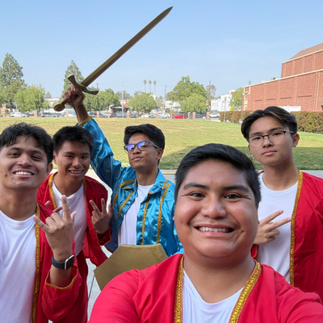


This spectrum of indigenization also mirrors the very geography of our Filipino archipelago. The Philippines is a constellation of islands separated by water, yet beneath the waves, we’re connected as one body. This is called archipelagic thinking: to understand ourselves as both dispersed and intertwined. It’s the same logic that sustains the Filipino diaspora. Being Filipino, whether in Manila or Daly City, Quezon City or Queens, is a dance across islands. Indigenization, then, is not a singular black-and-white thing; it is a spectrum of gestures: revival and remix, resistance and reinvention. This spectrum of indigenization, shown through our reverence, respect, and commitment to learning these dances and singing these songs, while considering our Western American influence, is central to how our culture and stories are perpetuated for generations to come.
Stay strong through the coming month! Troyphi’s still here for you, and remember that every day is a gift. Feel free to reach out to me at nostrati@usc.edu or at TP events. Good luck on the second half of the semester!!!!
Signing off,
Floyd Nostratis


Comments